

CAPSTONE
CAPSTONE
My Capstone project is called Bubzilla in the Ageless Consumption of Media. It is the culmination of my research, critical thinking, and creative work. In this project, a “text” isn’t limited to traditional writing; it can be a film, comic, website, game, or any artistic piece supported by a well-researched paper.
Through this project, I demonstrated my ability to analyze complex ideas, communicate clearly, and create work that reflects my perspective as an artist/designer. I defined a meaningful question in my field, explored why it matters, and connected it to my general education, major coursework, and studio experience.
This Capstone project brings all of those experiences together in a final piece that represents my transition into professional practice.
My thesis explores the following question: Why do we view some media, especially animation, as “childish” when it’s always been art?
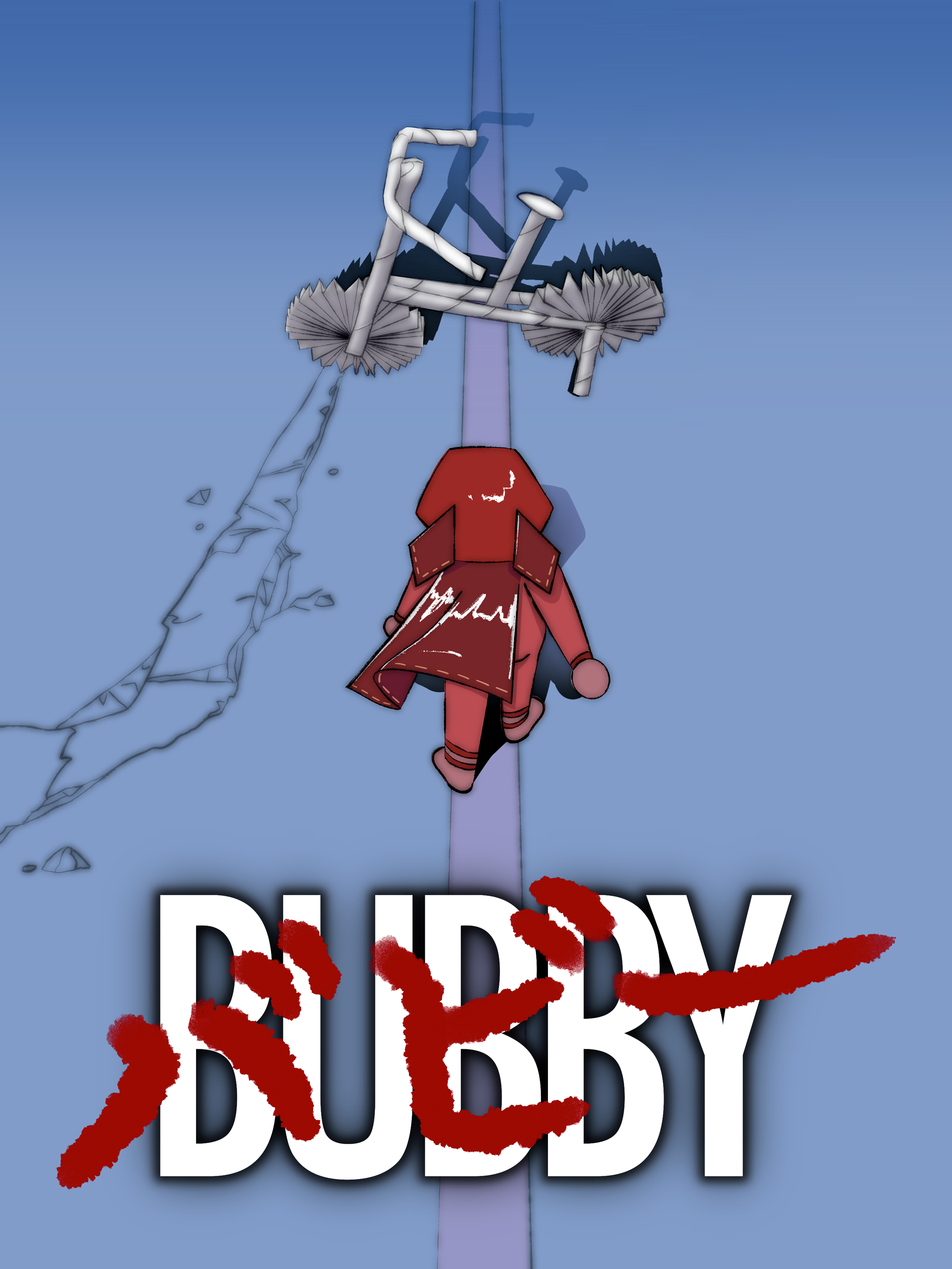
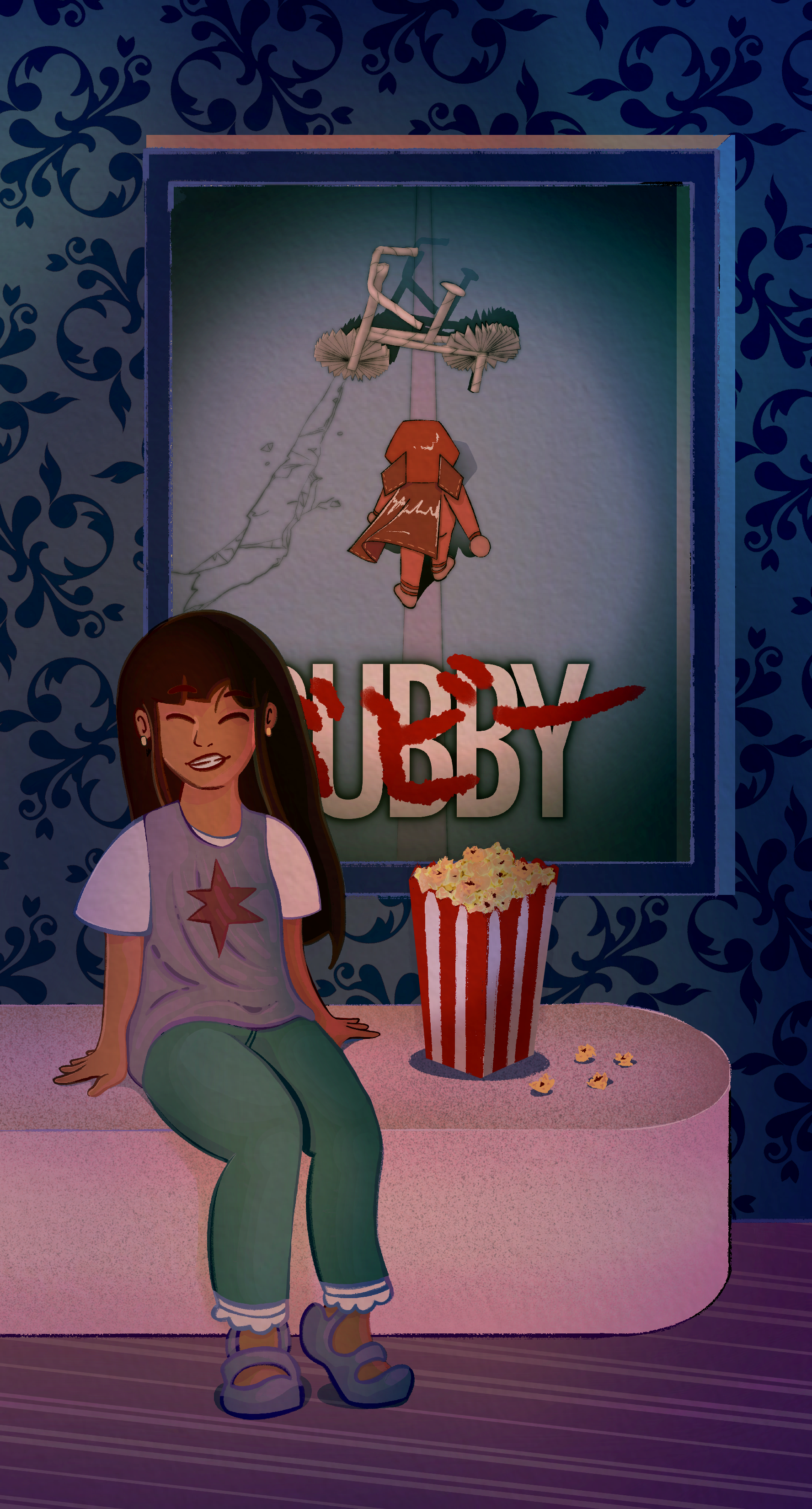
The Art
This work reflects my broader thesis question: why do we often view animation as “childish” when it has always been a form of art? This piece depicts me as a child sitting in a theater hallway, smiling as she excitedly sits in front of a version of the iconic Akira poster, with my character, Bubby, replacing the original figure Shotaro Kaneda (Akira). The poster draws on a social-media trend where people insert different characters into this image, connecting personal creativity with broader cultural practices.
By featuring Bubby in this poster, the work examines how children perceive animation as art, even when it is often labeled “childish.” The theater hallway represents a moment of encounter with media that feels larger and more significant than typical “for kids” content. We, the audience, are looking at a snapshot of little me’s perspective, which is why Bubby is depicted in the poster in the back, emphasizing how personal experiences shape the way we assign meaning and value to media.
At the same time, it reflects how media from childhood continues to influence our understanding of art and storytelling as we grow older. By combining a personal memory with a widely recognized image, the work demonstrates that animation can be both playful and profound, challenging the notion that it exists solely for children.
Bibliography
“Animation: artistic medium.” Encyclopaedia Britannica, Encyclopaedia Britannica, Inc., 24 Oct. 2025, www.britannica.com/art/animation.
Baemisaal, B. (2020, June 15). Sexual innuendos in children’s cartoons: In depth analysis. Medium. https://medium.com/@baemisaalbybae/sexual-innuendos-in-childrens-cartoons-in-depth-analysis-f0138333719f
“Bill Maher Responds to Stan Lee Backlash on Real Time.” The Hollywood Reporter, 25 Jan. 2019, https://www.hollywoodreporter.com/news/general-news/bill-maher-responds-stan-lee-backlash-real-time-1178754/.
“Children’s Television Act of 1990.” Congress.gov, 101st Congress, Public Law 101–437, 1990, https://www.congress.gov/bill/101st-congress/house-bill/1677.
Clements, Jonathan. “Akira (1988).” British Film Institute Screen Online, https://www.screenonline.org.uk/film/id/1288523/index.html.
Common Sense Media. “What Is Media Literacy and Why Is It Important?” Common Sense Media, 12 Oct. 2023, https://www.commonsensemedia.org/articles/what-is-media-literacy-and-why-is-it-important.
Densho Encyclopedia. “Japanese American Incarceration.” Edited by Brian Niiya, https://encyclopedia.densho.org/Japanese_American_incarceration/.
Ebert, Roger. “Up Movie Review (2009).” RogerEbert.com, 28 May 2009, https://www.rogerebert.com/reviews/up-2009.
Ebert, Roger. “WALL-E Movie Review (2008).” RogerEbert.com, 26 June 2008, https://www.rogerebert.com/reviews/wall-e-2008.
Exci, Jay. “Animation Is Not for Kids (And Never Was).” YouTube, uploaded by Jay Exci, 30 July 2022, https://www.youtube.com/watch?v=1nbXgDgJ-EY.
Federal Communications Commission. Children’s Educational Television: FCC Rules and Policies. FCC, 26 Jan. 2021, https://www.fcc.gov/consumers/guides/childrens-educational-television.
“Godzilla.” Gojipedia, Fandom, https://godzilla.fandom.com/wiki/Godzilla.
Hebdige, Dick. Subculture, the Meaning of Style. Methuen, 1979.
Author Credentials: Dick Hebdige holds a Master of Arts degree from the Centre for Contemporary Cultural Studies at Birmingham University and an honorary doctorate from Goldsmiths, University of London. He is an influential media theorist and sociologist, best known for his work in cultural studies and analysis of subcultures.
Audience / Type of Source: A scholarly book written for students, academics, and professionals in cultural studies, though it also interests the general public. It’s an academic and peer-reviewed text published by Methuen in 1979 and widely used in university and research settings.
Point of View / Objectivity / Bias: Hebdige writes from a cultural studies perspective, analyzing subcultures through a Marxist lens. His bias leans toward viewing style as a form of resistance to dominant culture rather than as mere fashion.
Currency: The book captures the historical context of punk and postwar British subcultures but while its core theories remain influential, newer subcultures have evolved beyond the 1970s setting Hebdige analyzed.
Coverage and Scope: Broad in theory but focused in application. Hebdige explores the concept of subculture through detailed case studies of 1970s British youth groups like punks, mods, and skinheads, while connecting them to larger ideas about culture, class, and resistance. The book provides an in-depth, theoretical analysis of how style communicates social meaning, which is well-suited for studying identity, aesthetics, and cultural expression.
Relevance: It provides a theoretical framework for understanding how style and self-expression forms identity and resistance. Hebdige talks about subcultures and the dilution of meaning while navigating mainstream influence.
Hern, Alex, and Kalyeena Makortoff. “‘Risks to Children on Roblox “Deeply Disturbing,” Say Researchers.’” The Guardian, 14 Apr. 2025, https://www.theguardian.com/technology/2025/apr/14/risks-children-roblox-deeply-disturbing-researchers.
Hisert, Julia. “Why I Hate the Term ‘Kidult.’” The Strong National Museum of Play Blog, 9 June 2023, https://www.museumofplay.org/blog/why-i-hate-the-term-kidult/.
Jeong, Se-Hun, and Dong-Hoon Choi. “Effects of Media Literacy Education on Children’s Media Interpretation and Wellbeing.” Journal of Media Literacy Education, vol. 14, no. 2, 2022, pp. 34–50. ERIC, https://files.eric.ed.gov/fulltext/EJ1344745.pdf.
Madigan, Sheri, et al. “Associations Between Screen Time and Children’s Language Development: A Longitudinal Study.” Journal of the American Academy of Pediatrics, vol. 146, no. 3, 2020, https://pubmed.ncbi.nlm.nih.gov/33013579/.
Mitkus, Tomas. “Aspects of Creativity in Adult Animation: An Overview of Censorship and Self-Censorship in Western Countries.” Creativity Studies, vol. 16, no. 1, 2023, pp. 39-49.
Author Credentials:
Tomas Mitkus is affiliated with the Department of Graphical Systems at Vilnius Gediminas Technical University, Lithuania. His research focuses on animation, media industries, and creative constraints.
Audience / Type of Source:
A peer-reviewed academic article published in the journal Creativity Studies. It is aimed at scholars, media researchers, and industry professionals interested in animation studies and media culture.
Point of View / Objectivity / Bias:
The article analyses structural issues in Western adult animation from a media-industry and cultural perspective. While it argues for animation’s potential, it also highlights real constraints (such as censorship, distribution bias).
Currency:
Published in 2023, it offers up-to-date analysis of the animation landscape, especially relevant given streaming growth and “kidult” cultural shifts.
Coverage and Scope:
Shows adult-themed animation has grown, yet remains marginalised in the West. It traces historical censorship, self-censorship by creators, distribution barriers, and how the “animation = children” perception persists. Its industry overview is valuable for cultural critique.
Relevance:
Shows that animation has been unfairly constrained by assumptions of childhood, and that adult audiences are legitimate.It supports my claims about how audience perceptions, industry practices, and market structures shape animation’s role.
Napier, Susan J. From Impressionism to Anime: Japan as Fantasy and Fan Cult in the Mind of the West. Palgrave Macmillan, 2007.
Author Credentials:
Susan J. Napier is a Professor of Japanese Studies at Tufts University and a leading scholar in Japanese literature, visual culture, and anime studies. She holds a Ph.D. in Comparative Literature from Harvard University and has published several influential works on Japanese culture, including Anime from Akira to Howl’s Moving Castle.
Audience / Type of Source:
A scholarly book written for students, researchers, and academics interested in Japanese studies, cultural theory, and media. It is an academic, peer-reviewed text published by Palgrave Macmillan.
Point of View / Objectivity / Bias:
Writes from a cultural and comparative perspective. Studies how Western audiences view Japan through anime. Aims to analyze rather than judge, though she favors seeing anime as serious art instead of simple entertainment.
Currency:
Published in 2007, the book is still relevant today for understanding anime and global fandom. While media culture has changed since then, Napier’s ideas remain a strong foundation for anime and fan studies.
Coverage and Scope:
The book explores how Japan has been imagined in Western art and media, linking historical movements like Impressionism to modern anime. Napier examines themes like fantasy, otherness, and fandom in depth.
Relevance:
Shows how animation can reflect culture and identity across borders. Napier’s work helps explain why anime appeals to adult audiences and why it deserves to be studied as a serious cultural form.
Ngoc, Nguyen Nhu. “Fan Awareness of Godzilla’s Dual Identity.” TV Multiversity, 29 July 2017, https://tvmultiversity.blogspot.com/2017/07/fan-awareness-of-godzillas-dual-identity.html.
The National WWII Museum. "Japanese American Incarceration" https://www.nationalww2museum.org/war/articles/japanese-american-incarceration. Published November 17, 2025. Accessed November 17, 2025.
Wells, Paul. Animation: Genre and Authorship. Wallflower Press, 2002.
Wells, Paul. Understanding Animation. Routledge, 1998.
Author Credentials:
Paul Wells is a professor and animation scholar who directs the Animation Academy at Loughborough University. He has written several books on animation and media studies and worked as a consultant for animation programs and festivals. His experience in both academic and creative fields supports his authority on the subject.
Audience / Type of Source:
This is a scholarly book published by Routledge for students and researchers in film and media studies. It is peer-reviewed and often used in university courses on animation theory and visual culture.
Point of View / Objectivity / Bias:
A bias Wells has is that animation is a serious art form rather than just children’s entertainment. He focuses on its artistic and symbolic potential, showing some bias toward elevating animation as equal to live-action film.
Currency:
Published in 1998, the book reflects animation’s shift into digital production and the growing influence of studios like Pixar. The theory remains useful even as animation technology has advanced.
Coverage and Scope:
Explores animation’s history, techniques, and storytelling methods. He uses examples from Disney, Warner Bros., and independent animators to explain how movement and timing create meaning. His analysis connects animation to broader film and cultural theory.
Relevance:
Supports the idea that animation is a medium capable of emotional and intellectual depth. Explains why animation should not be dismissed as childish and shows how movement itself can carry meaning and artistic intent.
Oxford University Press. “‘Brain rot’ Named Oxford Word of the Year 2024.” Oxford University Press – News & Insights, 2 Dec. 2024, https://corp.oup.com/news/brain-rot-named-oxford-word-of-the-year-2024/.